
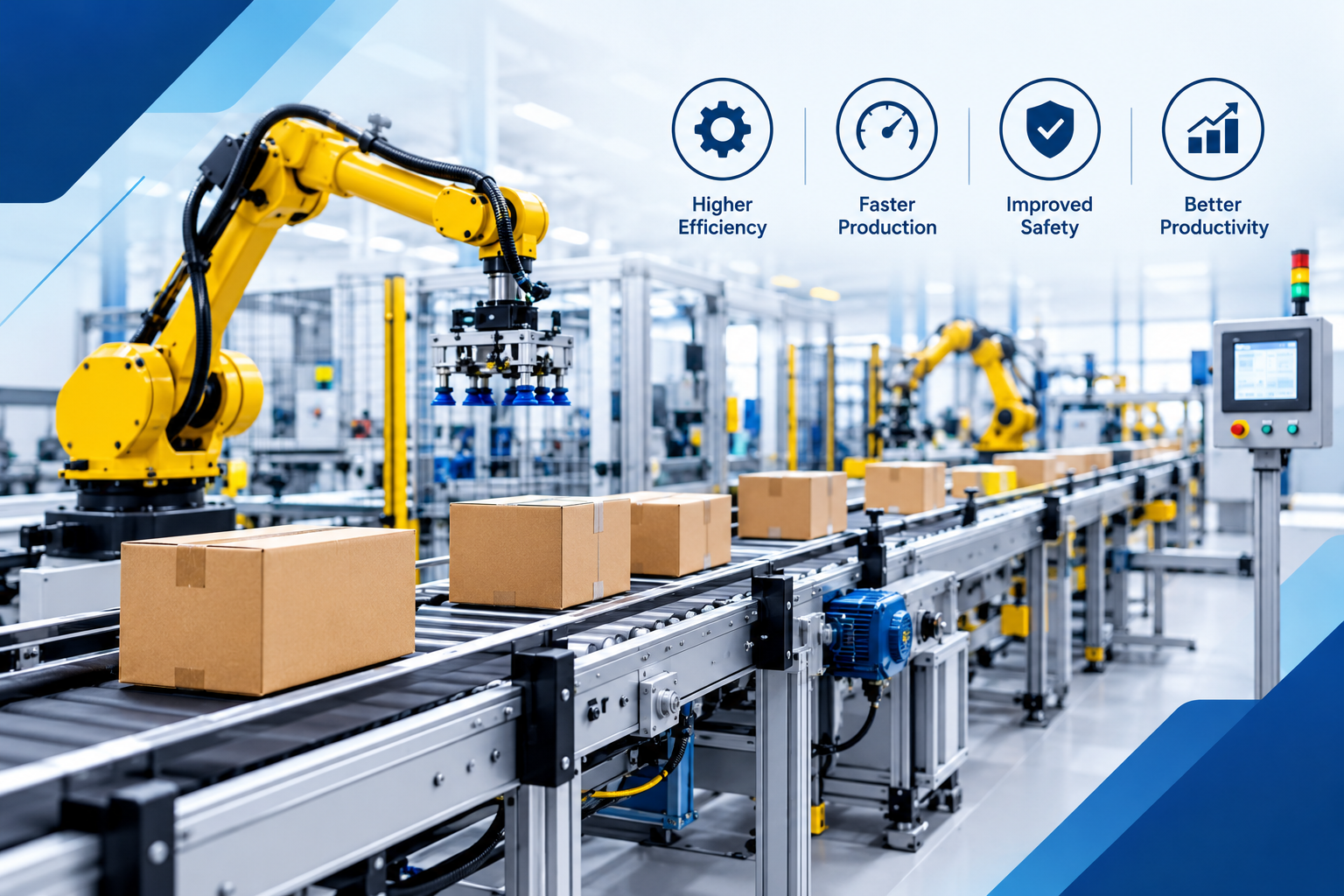
Modern Conveyor Automation Systems for Industrial Assembly Lines
Introduction
Conveyors are now an integral aspect of industrial manufacturing, automating conveyor systems in a wide range of industries to facilitate the movement of parts, control the flow of material, and synchronize the various stages of production. Automotive, electronic and computer products, engineering, packaging and consumer goods industries make use of conveyor systems to support continuous production.
Conventional material transport is generally done by hand, carrying items from one workstation to another, which results in longer production times and process disruptions. They are operated on a fixed route by mechanical equipment, sensors, motors, control systems etc.
An effective conveyor automation solution can aid manufacturers not just in boosting productivity but in maintaining quality, removing redundant handling and creating a more organized production environment. More modern systems may also be designed to work with automation controls and industrial equipment to meet future manufacturing requirements.
What Are Modern Conveyor Automation Systems?
Modern conveyor automation systems are composite material handling applications used to transport products, components and assemblies from one manufacturing operation to another. Sometimes these can be carried by belt, roller, chain, slats, pallets.
In addition, there are advanced conveyor systems which are equipped with PLCs (programmable logic controllers), sensors, VFDs (variable frequency drives) and HMIs (human machine interface). Such equipment can be used to control the conveyor speed, to monitor the product location, to synchronize workstations and to control flow of materials.
Take for example, one car parts manufacturer have an automated conveyor so they can move their parts from a workstation to an assembly line, then into a final testing room and then finally onto a packing line. This kind of systematic flow eliminates other forms of transports and provides a steady pattern.
The goal of conveyor automation is to enhance flow of materials while maintaining the productivity, safety and plant needs of a manufacturing environment.
Different forms of conveyor automation systems
Various industrial uses call for various conveyor systems. The right conveyor system is chosen by considering factors such as product size and weight, production line speed, and available space.
1. Belt Conveyor Systems
Belt conveyors transfer products from one work station to another using a formed, continuous belt. These types of conveyors are designed to work with light product, boxed products, small assemblies, and products and materials that have a flat conveying surface.
Advantages:
- Provides smooth and continuous product movement.
- Supports various product sizes and shapes.
- Can connect to inspection and pack-off stations.
- Reduces repetitive manual transportation.
2. Roller Conveyor Systems
Conveyors A series of rollers moves the product, box, container, and industrial component. They can be powered or gravity-fed.
Advantages:
- Appropriate for boxes, trays and some heavy products.
- Supports material transfer between workstations.
- Can incorporate accumulation and sorting mechanisms.
- Helps organize production and dispatch operations.
3. Chain Conveyor Systems
A typical application of chain conveyors is parts, fixtures and industrial operating conditions demanding heavy things. The design should be able to handle the load, environment and movement.
Advantages:
- Supports heavy-duty applications when correctly engineered.
- Provides controlled transportation for compatible products.
- Can integrate with automated manufacturing processes.
- Provides rugged materials handling for appropriate industrial applications.
4. Pallet Conveyor Systems
Pallet conveyor systems move parts that are hung on pallets or fixtures. They are ideal when products need to stay correctly oriented throughout assembly, testing, and inspection.
Advantages:
- Maintains consistent product positioning.
- Supports coordinated workstation operations.
- Can accommodate different production sequences.
- Facilitates tracking of product when apt identification technology is loaded.
Major Benefits of Conveyor Automation in Manufacturing
When the automation is based on actual production requirements, these can be some of the key benefits of conveyor automation.
1. More Efficient Manufacturing
An Automated conveyor system moves items from work station to work station in accordance with a defined process. An Automated conveyor system can help to minimize unneeded movement and decrease setup time from one operation to another. In addition to helping conveyor belts work with assembly machines, conveyor belts allow companies to optimize production and bring bottlenecks into focus.
2. Reduced Manual Material Handling
Manual Handling is labour intensive and requires time if loads are heavy or being moved many times over. Conveyor automation eliminates the repetitive pushing, pulling and carrying.
In this way the employees are free to spend more time on assembly, quality testing, operating machinery etc. This can facilitate the efficient utilization of labour and support the better organization of production.
3. Consistent Product Quality
Loose material movement may result in dropping, scratching, improper positioning and handling damage.
A well-designed conveyor system allows more controlled movement and more repeatable product placement. Along with inspection equipment, sensors and cameras, it can enable quality checks at various points in a production process.
4. Better Production-Line Coordination
Multiple stages are typical in an industrial assembly line that incorporates loading, assembly, testing, inspection, and packaging. A stall at a workstation may cause idle time throughout the whole production.
Automated conveyors can be used to synchronize the flow between these. PLCs and sensors may be used to select stopping points, transfer order and interlocks for equipment to ensure a more ordered process.
5. Improved Workplace Safety
Automating some of the transportation of material can eliminate some of the ergonomic risk and the dis-economies of movement.
But conveyor systems come with mechanical dangers too. Machine guarding, emergency stops, interlocks, access, and maintenance are all vital in ensuring the safety of the machines.
6. Efficient Use of Factory Space
You can choose conveyor systems based on the warehouse layout. Straight, curved, inclined and overhead models may assist manufacturers to align the flow of materials around machinery and work areas.
A carefully designed layout will eliminate all unnecessary transportation routes and facilitate better coordination between various production sections.
7. Simpler Production Tracking
With proper control systems and sensing conveyor automation is capable of monitoring equipment status, product movement, cycle times, and failures.
Manufacturing managers can use this data to analyze common delays, optimize planning, and utilize it for more accurate scheduling of maintenance.
Applications of Conveyor Automation
What modern conveyor automation systems can do?
Automotive Manufacturing Conveyors transfer automotive components and assemblies, fixtures and metal castings from one manufacturing process to the next.
Electronics Manufacturing: Assembled enclosures, printed circuit assemblies, electronic components, and completed products are conveyed through various phases of assembly and inspection with the use of the correct conveying systems.
Engineering industries: All sorts of machined parts are transported from one process to another using conveyor systems.
Packaging Industries: Cartons, containers and finished products are conveyed for filling, sealing, and labeling; for inspection; and for shipping.
Consumer Goods Manufacturing: Automated conveyors can be used for product assembly, sorting, inspection, and packaging.
The plastic parts and composite engineered plastic components on the conveyor systems are delivered to and from the manufacturer. There is also a need for applications to have a proper design considering the product's weight, size, environmental conditions, and production needs.
Factors to Consider When Choosing a Conveyor
Step one for the selection of a conveyor automation system is to get you manufacturing process.
1. Product specifications: Always read the specifications of the product, including shape, weight, size, and even stability.
2. Production capacity The number to be produced per hour/shift and the conveyor speed.
3. Factory layout: you have the available floor space, how workstations are in layout, transfer height and the ease of serviceability.
4. Control integration: Are PLCs needed, sensors, variable frequency drives or machine communication?
5. Safety requirements: Identify the safety requirements for guarding, emergency stop, access to the operator and safe maintenance.
6. Maintenance requirements Equipment flexibility, spare parts, how to clean the machine, how to access the moving parts.
7. Would that be just a matter of the number of product or line changes?
8. Total cost of ownership: Weigh the installation cost and compare with energy consumption, maintenance cost, Downtime, and estimated savings.
Role of Automation Technology in Modern Conveyor Systems
Advancements in conveyor technology include the automation of conveyor operation. PLCs controlled programming sequences of operation and sensors detect the product and some of the operating parameters. Variable frequency drives change the motor speed to the desired output.
Operator interfaces allow operators to monitor the system and take control actions. As applicable, conveyor systems may be integrated with robotic devices, inspection stations, bar code readers, and manufacturing software.
Each of these technologies allows a manufacturer to contribute to the linkage of the flow of materials, help prevent specific process disturbances, and improve the real-time visibility. Automated levels can be configured based on the size and type of the plant.
Frequently Asked Questions
Q1. What does industrial conveyor automation system mean?
An industrial conveyor automation system helps to transport products and components from one processing stage to the next, using mechanical conveyors and sensors (and automation controls if necessary).
2. What are the main advantages of conveyor automation?
Here are the biggest advantages of working with HMI systems: more productive, less manual handling, far more steady movement of material, more optimized flow, more effective use of space and easier to follow production.
3. Which conveyor is suitable for an assembly line?
You may select from a belt, roller, chain or pallet conveyor belt. Your choice would be based on the weight and size of your product, your required through put, handling needs and the space available to you.
4. Can conveyor systems integrate with PLCs and sensors?
Yes. Conveyor systems that are compatible with other automation equipment such as PLCs, sensors, variable frequency drives, etc. can work together to provide synchronized workflows and workstations.