
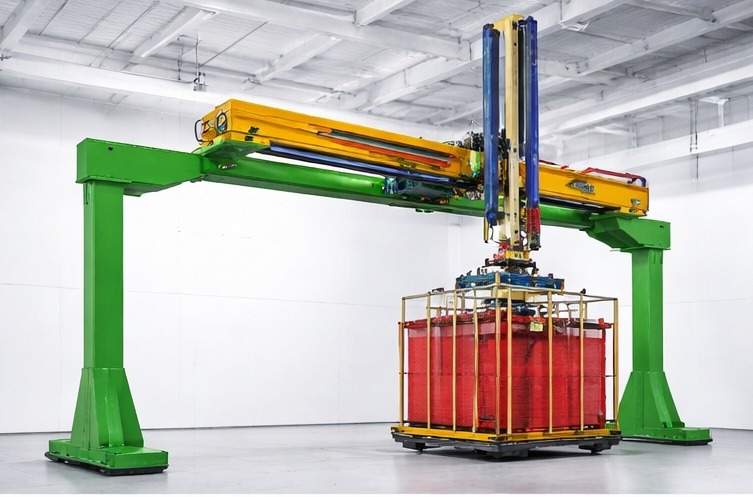
Axis Pick and Place Gantry System: Smarter Automation for Modern Production Lines
Manufacturing floors across India are under constant pressure to produce more, faster, and with fewer errors. One technology that has quietly become central to this shift is the Axis Pick and Place Gantry System a robotic material-handling solution built to move components from one point to another with speed and repeatable accuracy. Whether it's placing a delicate PCB, transferring a heavy metal casting, or sorting packaged goods on a conveyor, an Axis Pick and Place Gantry System removes the guesswork and inconsistency that come with manual handling.
What Is an Axis Pick and Place Gantry System?
The basic design of an Axis Pick and Place Gantry System in Pune comprises rails and carriages driven by motors, carrying either a gripper, a vacuum head, or any other tool to the intended destination within a particular workspace. In contrast to the conventional robotic arm, which has to be able to reach everywhere in space, the gantry system moves along the set of axes similar to the head of the 3D printer, yet designed to carry loads significantly more substantial than what printers deal with. Motors, drives, and actuators move the carriages along axes in a coordinated manner by a program controlled by PLC or CNC.
This mechanical confinement to the set of axes allows the system to achieve precision unattainable for human workers and, in some cases, even for free-moving robotic arms.
Axis Configurations: From Simple to Complex
Not every application needs the same amount of motion freedom, which is why Axis Pick and Place Gantry Systems come in several configurations:
- 1-Axis systems move along a single straight line and suit simple transfer tasks.
- In a 2-axis system, another linear axis is added to allow movement on a flat work surface.y
- In a 3-axis system, the Z axis is added to allow pick-up and drop-down action on the X, Y, and Z planes.
- In a 4-axis system, a rotating axis is added above the three linear axes where there is a need to rotate the part before placement.
- In 5-axis and 6-axis systems, another tilt/rotation axis is included.
Choosing the right axis count is largely a function of part geometry and the precision the downstream process demands; over-specifying axes adds cost, while under-specifying limits flexibility.
How Motion Style Affects Performance
The type of movements that a gantry will make in space can influence its capabilities, other than just the number of axes:
1) Cartesian gantries only move in straight lines within an enclosed rectangular volume along the X, Y, and Z axes, making them perfect candidates for CNC feeding, 3D printing assistance, and general assembly. Polar gantries will replace those linear movements with rotations and radius-based movements, a better option when you need to weld or apply paint.
2) Delta-style units use three arms operating in parallel to achieve very high cycle speeds, though usually at lower payload limits, ideal for light, fast picking such as small food items or electronic components. Cylindrical gantries combine a vertical linear axis with rotation, which works well for tasks centered around a fixed point, such as pipe welding or vertical stacking.
Why Manufacturers Are Switching to Gantry Automation
The justifications behind implementing the Axis Pick and Place Gantry System are essentially five-fold, and include:
1) A reduction in reliance on human workers for monotonous jobs prone to causing fatigue; hence, a reduction in problems of staffing at times when there is high employee turnover. Cycle times that surpass those of a human worker within an 8-hour shift. Precision of placement to the micron level, thereby minimizing wastage of time on rework and materials. Scalability as adding another gantry system unit to the existing line is much easier than redesigning the entire layout. Adaptability in terms of tooling, making the gantry frame capable of accommodating new grips or suction cups in order to adapt to the changing production line products.
2) In essence, all these combine to provide justification for implementation within a reasonable payback period.
Where These Systems Are Used
Axis Pick and Place Gantry Systems show up across a wide range of industrial settings. These robots are used in electronic industries to place sensitive parts onto printed circuit boards (PCBs). They also transport vials, syringes, bottles and other containers on assembly lines in pharmaceutical and medical device manufacturing without any contamination risks. The automotive industry uses them for positioning sensors and other delicate parts. Food and beverage manufacturers use gantries for product sorting and loading onto trays and conveyor systems. Consumer goods manufacturers use gantry robots for handling cosmetics, household goods and many others.
An Axis Pick and Place Gantry System in Pune isn't just a piece of equipment; it's a structural upgrade to how a production line handles parts. By matching the right axis configuration and motion style to the job, manufacturers can cut labor costs, tighten quality control, and scale output without constantly adding headcount. For businesses in and around Pune exploring this shift, working with an experienced local integrator such as Triz System in Pune offers a practical way to get a system that's engineered specifically for the parts, payloads, and speeds the line actually needs, not a generic solution stretched to fit. Floors across India are under constant pressure to produce more, faster, and with fewer errors. One technology that has quietly become central to this shift is the Axis Pick and Place Gantry System, a robotic material-handling solution built to move components from one point to another with speed and repeatable accuracy. Whether it's placing a delicate PCB, transferring a heavy metal casting, or sorting packaged goods on a conveyor, an Axis Pick and Place Gantry System removes the guesswork and inconsistency that come with manual handling.