
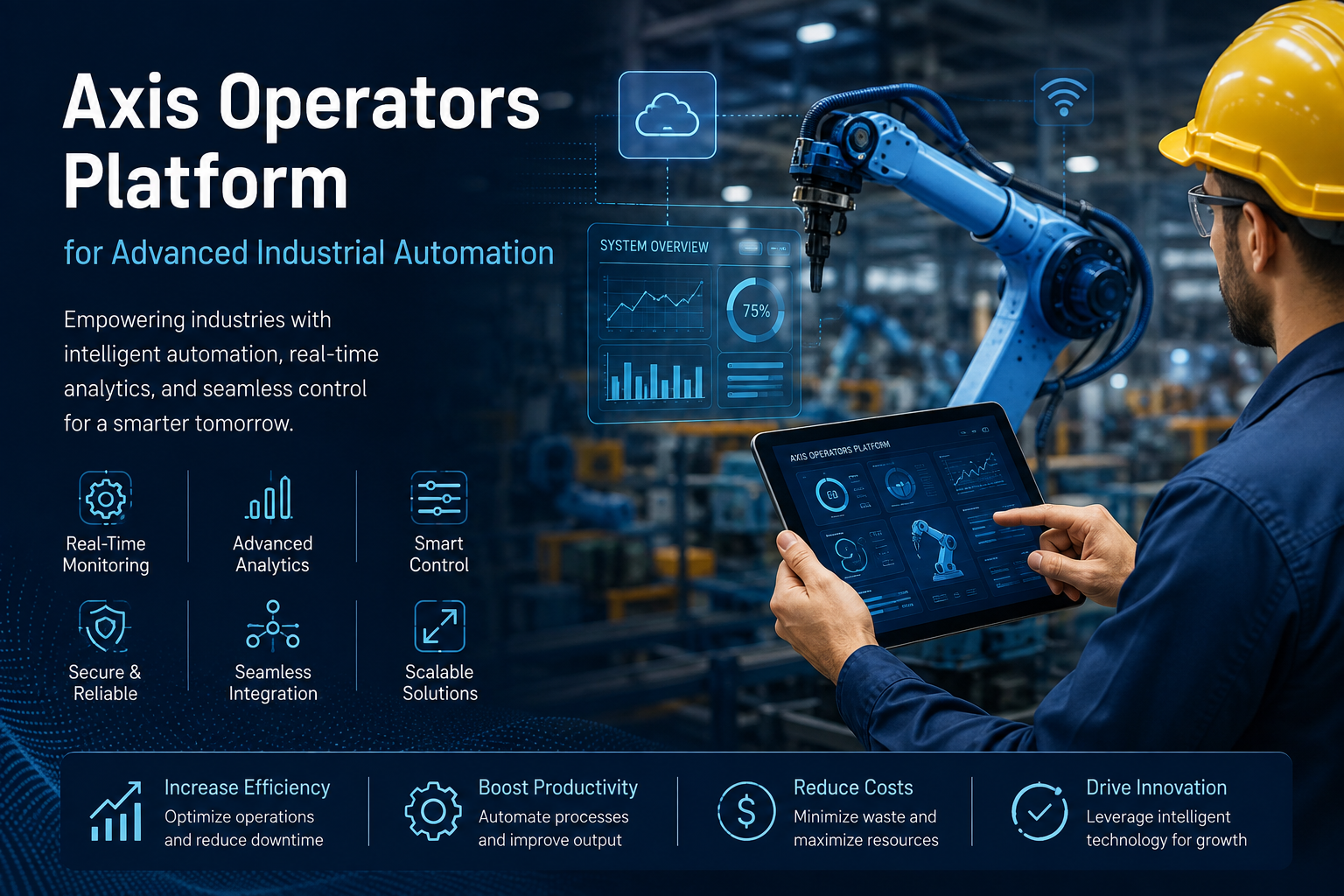
Axis Operators Platform for Advanced Industrial Automation
Increasing productivity, improving machine control, and assuring the consistency of production quality are key considerations as industrial automation becomes a larger part of the manufacturing landscape. However, as the manufacturing process becomes increasingly automated, operators will still need to be able to monitor, control, and manage machines effectively. An Axis Operators Platform can support these needs by serving as a functional man-machine interface (MMI) solution for operating machinery and automation tasks.
An Axis Operators Platform can be used in a wide range of industrial environments where high accuracy, a smooth production process, and efficient interaction between human operators and machinery is needed. By uniting operator-oriented controls with automation functions, the Axis Operators Platform can assist in redefining how production systems are managed.
What is an Axis Operators Platform?
An Axis Operators Platform is designed to function as a system that can help an operator to organize the interface needed to control a piece of industrial machinery. It can centralize a range of different, and equally important, functions and machine capabilities for the operators.
Instead of expecting a given operator to navigate multiple, disconnected controls, an Axis Operators Platform centralizes the operation of a machine in a user-manageable platform. Based on an application, the interface can display monitoring tools for machine status, allow parameters to be adjusted, implement control of production operations, send fault alerts, and display operational data. The available functions will depend heavily on the specifics of the machine, automation architecture, and application.
The role of Operator Platforms in Automation
Even though complex systems are highly automated, operators will still need reliable tools to be able to monitor the production environment and to adapt controls when necessary to satisfy operational needs. An effective operator platform allows humans and automated machinery to maintain control over a well-integrated and responsive production system.
An Axis Operators Platform can help provide machine data to enable an operator to gain a clear understanding of machine conditions and enable correct operation where necessary. An organized layout and clear display will allow an operator to alleviate confusion within his or her daily routine management of a particular machine. These tools are especially critical in manufacturing environments because machinery may need to run around the clock and production staff will need immediate access to relevant production data.
1. Machine Control
A primary aspect of the Axis Operators Platform that an operator may depend on is its ability to centrally manage the machines that an operator uses on the production floor. Rather than having individual machines requiring physical input with different controls, the operator interface allows an operator to use structured, relevant information to access these machines with a coordinated interface.
Improved command will assist production teams to have better operational control of a machine's settings, machine parameter inputs, and specific control over any of the processes in an operation. Consistent operations through centralized command allow for efficient repetitive production operations using specific machines. With the corresponding automation hardware and software, an Axis Operators Platform can create more manageable manufacturing systems and production.
2. Real-Time Monitoring
One very important characteristic of machine automation is machine monitoring. Production management may require that a human operator observe the status of machines during operations to determine whether there is anything that needs to be brought to their attention or addressed. An Axis Operators Platform is capable of displaying and coordinating relevant machine information in a clear and coherent format. When integrated, operators should theoretically be able to access any machine parameter and status data that is useful.
3. Error Reduction of Operations
Processes within a factory may rely on the operation of various parameters and input mechanisms. Without an accessible interface or organized feedback, errors may appear that could potentially be prevented with the proper machine controls. An organized user interface provided by the Axis Operators Platform can provide an operator the ease needed to efficiently control each machine without errors while simplifying operational use and reducing time spent searching for specific controls or information to perform certain tasks.
4. Support for Industrial Productivity
Production is driven by several different characteristics of an automated system, including availability, production, the efficiency of operations, and human input. By centralizing control and allowing for quick access and effective display of important machine operational data, an Axis Operators Platform can add to machine productivity by preventing delays between operator actions and required machine responsive actions. Increased immediate feedback of available information on a particular machine allows for quick operational problem-solving between the operator and the machine automation system. Hence, an Axis Operator Platform adds value to an automated system, as it not only interacts with an operator interface; the component assists the broader systems working within the factory automation infrastructure.
5. Product application throughout manufacturing
Operator platforms can serve several functions. They may work with a production line and its automation components; they may integrate an integrated parts feeding machine, and they can be part of a machine handling equipment system. Various applications would rely on the use of such systems throughout.
The requirement that each particular function receive feedback or respond differently may prompt different designs and configurations of operator platforms according to the specific input required for different pieces of machinery. It offers versatility for highly customizable systems or simpler designs that may just take multiple inputs from many different tools and give feedback to one central console for a better operational experience to be provided.
6. Interaction within Automation System
The automated system will typically include several individual components, including but not limited to the PLC controller, feedback from sensors, the motors and drive mechanisms, the communications interfaces like ETHERNET/IP, and the various software involved in control. This interaction can be facilitated by a person interface, and the appropriate design of controls is paramount so that operators are able to access relevant inputs from the system. Operator systems can allow communication across systems that are programmed differently by the machine manufacturers but offer the ability to have their status reflected to the operator so that communication can be optimized for production efficiency. Planning this is vital in an industrial setting, considering machines operate throughout the plant, to determine the way a particular system's inputs communicate.
Designing the interface for the operator for effective functionality and an efficient and productive workspace is the main aspect to consider. The platform, through effective design, gives personnel better control by optimizing operator efficiency.
7. Selecting an appropriate Automation Solution
As with any machine, there needs to be a design process that includes input about operator functions, number of axes to control or read, and automation requirements. Automation components, including interface control, should match the machine being utilized. Considering both the controller as well as other supporting parts ensures optimal efficiency. A manufacturing company seeking Automation solutions to integrate their process equipment or entire factory into higher productivity standards could look at a group such as Triz System in Pune, a specialized company offering robotics and automation solutions to fit any business needs.